

| Home | Dr. Mha Atma's Health Newsletter | Ideas for Good Health | Patient of the
week |
| >About |
| >Meet The Doctor |
| >Meet The Team |
| >Testimonials |
| >Hall of Fame |
| >Upcoming Schedules |
| >Contact Us |
| >New Patient Forms |
| >Exercises |
| >Links To Better Health |
| >Videos |
| >Why go to a Chiropractor? |


Breath
By Mha Atma S Khalsa, DC
Every breath you take has a profound effect on the quality of your life. Improper breathing patterns are extremely common, and they are a subtle but major source of pain and many health problems. The good news is that by simply becoming aware of and improving the quality of your breathing, you may experience significant improvement in your physical and emotional well-being.
The diaphragm is a large, dome-shaped muscle at the bottom of your rib cage, extending back to your spine, which is primarily responsible for breathing. When you take a full, healthy breath, your diaphragm contracts, your abdominal and chest muscles relax, and your abdomen and then chest expand as the air is sucked into your lungs. As you exhale, your diaphragm relaxes and your abdominal muscles may contract slightly.
To test your breathing habits, lie flat on your back with one hand resting on your chest and the other on your abdomen. Take a full, deep breath. If your abdominal hand rises, followed by the hand on your chest, you are breathing properly. If only the chest hand rises, you are one of the many folks who have developed a habit of holding tension in the abdominal muscles and breathing mostly in the chest. This shallow and/or restricted breathing can contribute to neck tension and pain, headaches, back pain, digestive problems, fatigue, and a host of other maladies. Watch your breath patterns throughout the day. Even if you are breathing deeply and properly while relaxed on your back, you may find that when you are sitting, working, driving, and involved in other activities, particularly when under stress, your breathing becomes more shallow and restricted.
The remedy? Practice deep, relaxed breathing first while lying on your back, consciously breathing into your abdomen so that as you inhale the hand on your tummy rises first, followed by the hand on your chest. Do this for a few minutes a day, until taking a full deep abdominal breath is quite comfortable and easy. Then check yourself whenever you can remember while you are working and in other active situations, and when you catch yourself with restricted breathing take a few deep, full breaths, feeling first your abdomen and then your chest expand. Folks who have had longstanding dysfunctional breath patterns often develop motion restrictions in the spine and rib cage, and may find that chiropractic treatment speeds their ability to improve their breathing habits. And they will find that improving their breathing habits leads to more lasting benefits from chiropractic.
As you become aware of your breathing patterns, and as you improve them, you will experience less tension and pain and more energy, relaxation and awareness. You can start now, with one deep breath.
Breathing Practice
Part One
 |
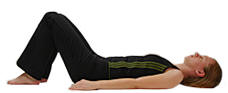
Lie on your back, arms by your sides, knees bent (maybe a pillow under your knees), feet flat at a comfortable distance apart and from your hips. |
|
|
Inhale while gently arching your lower back off the floor. Exhale while flattening your lower back into the floor. |
|
|
Let this breath cycle be slow & easy: about 4 or 5 seconds on the in breath and the same on the out breath. Allow your neck & jaw to relax. Your chin may drop slightly while inhaling and release while exhaling. |
|
|
Continue for about 10 consecutive breaths. |
Part Two
Still on your back, knees bent, arms at your sides, palms down: Gently roll your knees side to side, rolling your head in the opposite direction. Repeat five times in each direction.
Part Three
Bounce the Ball: Lie on your back, knees flat or bent, arms down by your sides, inhale into your belly & hold your breath. Begin to bounce the ball of breath up & down in your belly, moving the ball up towards your rib cage & then down to your lower belly. Continue for as long as you are able to hold the breath, then exhale & relax. Repeat twice. Relax.
The Key: keep it in the zone of ease & fun. Do only as much as you want to. Don’t force yourself. Do all parts or only one part. Part one can be done while seated, walking or standing once you get the feel of it.